 Member of European University Association
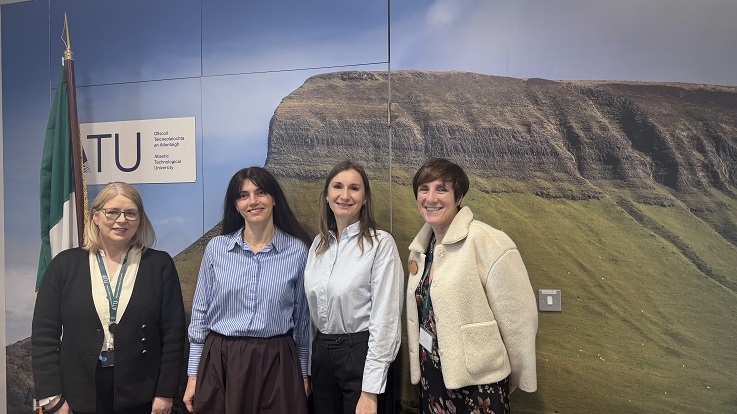
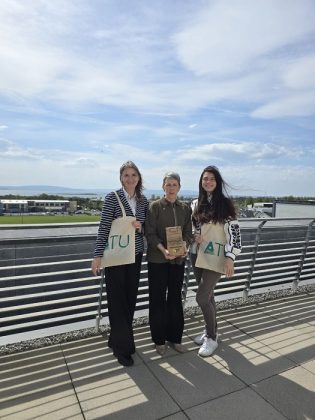
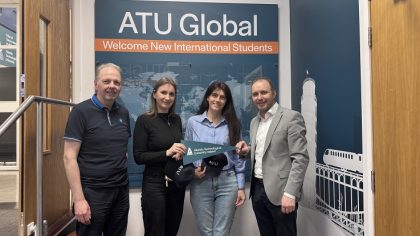
April 20-25, researchers from Ternopil Ivan Puluj National Technical University — Nataliia ZAHORODNA, Head of the Department of Cybersecurity, and Oksana SITKAR, Head of the Department of Physics — conducted a working visit to Atlantic Technological University (ATU) in Ireland.
The visit took place within the framework of the developing Twinning partnership between TNTU and Atlantic Technological University, which has been ongoing since 2023, and in the context of implementing the Memorandum of International Cooperation signed between the universities on April 16, 2024. The cooperation is coordinated on behalf of TNTU by Dr. Sc., Prof. Tetiana VITENKO.
The collaboration between TNTU and ATU began under the All-Ukrainian “Unity Initiative” and the Twinning Initiative, aimed at supporting Ukrainian universities, developing academic partnerships, exchanging institutional experience, expanding access to educational and research resources, and creating opportunities for joint educational and research projects.
An important stage in establishing this partnership was a series of working group meetings between TNTU and ATU held throughout 2022–2026. Discussions focused on providing TNTU with access to library resources and digital databases, particularly those supporting Twinning projects. As a result of this cooperation, TNTU gained access to research content through open-access resources and the Research4Life initiative, and options for access to the Linda Hall Library resources were explored. Another significant milestone of the partnership is TNTU’s inclusion as an associate partner in the European University Alliance EU GREEN, of which Atlantic Technological University is a full member. This opens up additional avenues for TNTU to integrate into the European Higher Education and Research Area, develop joint initiatives, exchange best practices, and participate in international projects.
Atlantic Technological University is one of Ireland’s leading technological universities, formed through the merger of several higher education institutions. The university operates campuses across western and northwestern Ireland, offering a wide range of undergraduate, postgraduate, and doctoral programs in engineering, information technology, natural sciences, business, humanities, and social sciences. ATU brings together over 18,000 students and approximately 2,000 staff members.
During the visit, the TNTU delegation toured the ATU campuses in Sligo and Galway, where they had the opportunity to explore the university’s educational, scientific, and innovative infrastructure. Working meetings were held with the leadership of Atlantic Technological University, including ATU President Dr. Orla Flynn, vice-presidents, and representatives of departments responsible for international relations, educational environment development, inclusion, digital services, student affairs, and quality assurance in education.
Special emphasis was placed on meetings with ATU faculty members and researchers. The discussions explored prospects for cooperation in information technology, cybersecurity, machine learning, STEM education, virtual reality, digital twins, and other cutting-edge technological fields. Such institutional links are of paramount importance, as direct interaction between departments, lecturers, and research groups forms the practical foundation for future joint projects, academic mobility, and co-authored publications.
The itinerary also included a meeting with the Vice President for Globalization at ATU and Director of the International Relations Office, John Andy Bonar. The discussions outlined promising directions for future cooperation, including the development of academic mobility, the preparation of joint educational and scientific initiatives, the strengthening of interdepartmental contacts, and the expansion of TNTU’s participation in international university networks.
The partnership between TNTU and ATU serves as an exemplary model of effective international cooperation, which began as a support initiative for the Ukrainian university amidst wartime challenges and is now steadily evolving into a strategic interaction between higher education institutions. This collaboration enhances academic opportunities for students and faculty, advances joint educational and research fields, and strengthens TNTU’s international presence.

More from the site:
 1 Feb 2023 Some representatives of the company “Ustronianka” (Poland) visited TNTU.
 25 Mar 2025 Ternopil Ivan Puluj National Technical University ranks high in the international Webometrics ranking.
 19 Jul 2025 TNTU Scientists Participate in International Workshop on Remote Labs at Wrocław University of Science and Technology
 5 Jul 2021 Ternopil Ivan Puluj National Technical University is among the top 15th universities in Ukraine
 9 Nov 2022 Ukrainian Writing and Language Day
 3 Feb 2026 TNTU scientist participates in NATO Science for Peace and Security (SPS) program
 2 Dec 2025 TNTU Once Again Confirms Its Openness to the World and Strengthens International Partnerships
 22 Mar 2023 TNTU is among the 25 top HEIs in Ukraine